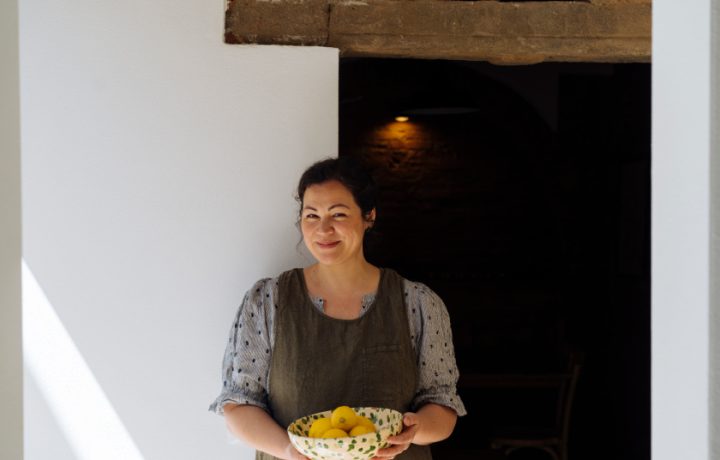
How I Got Here: Italian-based cookbook author Emiko Davies
Posted on
Admit it, we’ve all been there – stalking social media and LinkedIn profiles, trying desperately to figure out how the hell someone got their dream job.
It seems impossible and yet there they are, living out your career fantasy (minus the itchy business suit). It might seem hard to believe, but once upon a time, they were also fantasising about their future career, and with some hard work, they made it.
Welcome to How I Got Here, HerCanberra’s series that reveals everything you want to know about the secrets of career success. This week, we meet international food writer Emiko Davies.
Existential crisis time: Who are you and what do you do?
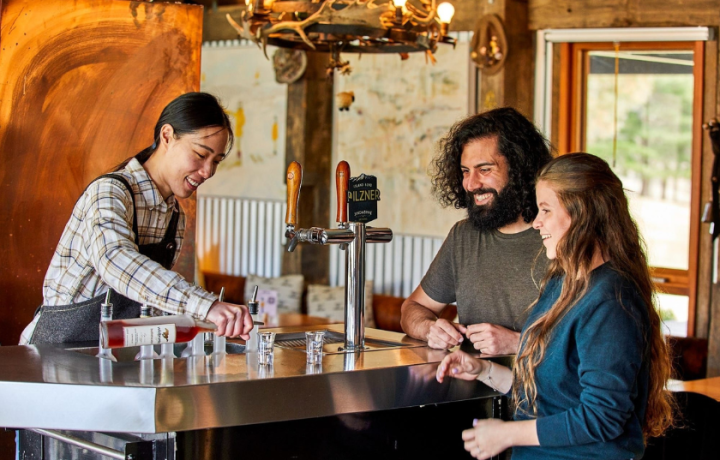
I wear many hats: an incurable multitasker, a food writer, photographer, blogger (if people still read blogs), bar keep (my sommelier husband and I opened our own natural wine bar three years ago) and author of seven cookbooks.
Originally from Canberra, I have lived in Tuscany for the past 20 years, where I fell in love with food and history. My husband and I finally opened our dream wine bar, which we also use as a space to run cooking classes and culinary workshops on Italian food and wine, but more recently I have been writing about my Japanese heritage and now run culinary retreats in Japan too.
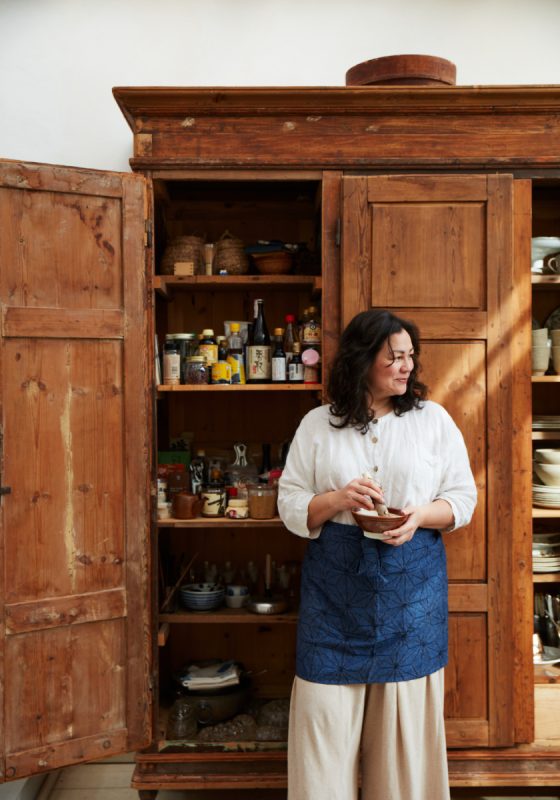
Let’s go back to when you were a kid, have you always dreamed of working in this industry?
When I was a child, I loved drawing, reading and writing. I was a bookworm. I have notebooks of my scribbles from when I was about nine and ten years old and it is funny to look back on them now, but in one of them, I have even written down the address of the publisher I intended to send my book to. So even though by the time I went to university, I had an idea to do something completely different (I went to the US to go to a prestigious art school for a Fine Art degree, and then onto Florence to study art restoration), I suppose you can say the seed had already been planted long ago to become a writer.
Tell us about when you were first starting out, what set a fire in your belly to get here and how did you do it?
I was working as the sole art restorer in Europe’s biggest photography archive in Florence and frustratingly, getting paid next to nothing. We had to move in with my new mother-in-law just to get by and when I explained this to my boss in a plea to get a raise, his only response was, “Doesn’t your husband work?” I could feel the steam come out of my ears and I quit on the spot. After that, I decided I needed to do something for myself, but something where I would be keeping my hands busy (which is when I am at my happiest). So I started a food blog.
It was simple, really: writing, talking about food and history, taking photographs. All of my favourite things in one. I loved reading Elizabeth David; her cookbooks were like novels to have by the bedside table, and this became inspiration for my blog. I had no idea how to start a blog, but I bought a website and taught myself how to navigate WordPress and decided from day one that this would be something for me — who knew who would ever read a random blog about Italian food traditions in 2011 anyway? But once a week, I would post a new article, a recipe, a deep dive into the history and stories behind it and about three years later, I got an email from a publisher asking me if I would like to make a cookbook.
Recall a time when you wanted to chuck it all in; what did you tell yourself when it got too hard?
It had been my dream to be a published author and it still is, but it is really hard and something that no one ever tells you is that it is actually incredibly unglamorous to be a cookbook author. Behind the scenes of it all, there are hours and weeks and months of lonely work, writing, recipe testing, not to mention loads of dishes to wash! With an advance that only covers one or two months’ worth of salary, but a project that requires 18 months of work, for months on end, you struggle to make ends meet, unless you have another job. I didn’t, as I had two small children born 5 years apart (a terrible idea) to look after at home, so I couldn’t have done any of this without my husband’s steady job as a sommelier at the Four Seasons in Florence for most of that time.
We lived paycheck to paycheck; during one particularly hard moment, we were paying with our groceries with just copper coins. We have lived like this for years, and my husband diligently kept his steady job so that I could pursue my dream of writing. However, I can tell you that there were plenty of times when I thought, ‘Maybe I should forget this and just get a regular job.’ Then I remember how much I love doing what I do and fall in love with another idea for a book.
What was your biggest break?
My big break came after a few years of blogging. By this point, my blog had a regular following and I had a column for Food52 on regional Italian food, which then (2014) was a huge platform for foodies and food writers, with an active and enthusiastic community of home cooks. I received an email from my first publisher (Hardie Grant), asking me if I had ever thought of writing a cookbook. It was the ultimate pinch-me moment. I happened to be going to London that year, so we met and talked about what writing a cookbook would be like, but ultimately, I changed publishers to the Australian office, and was left to send in a proposal on my own to Melbourne.
That first book, Florentine, which came out in 2016, was and still is my best-selling book and still the only book about the cuisine and history of Florence written in English, so I am immensely proud of that. It led me to being a consultant for people like Sarah Winman, author of Still Life, which is set in historical Florence, and Stanley Tucci, who I took to eat my favourite tripe sandwich in Florence for his latest show, Tucci in Italy.
What’s the best piece of advice you’ve ever received?
When I was at art school, I was torn between going towards a Fine Arts degree in Printmaking, which is very much hands-on, very “analogue” and creative, and a degree in Graphic Design, which seemed to me to be more “practical” solution that would help me get a job. I had a great teacher who helped put things into perspective by asking me what I like to read. It seemed like a completely unrelated question but I told him about some of my favourite books and authors — Bulgakov’s The Master and Margherita, Gabriel Garcia Marquez’ books, Albert Camus. He immediately said: Take printmaking.
His reasoning was that if I had started rattling off magazines or design books, he would have seen that I was really interested in design. But he could see that in my heart there was art and the fantastical worlds of the books I loved to be taken into. I am forever grateful to his insight because I realised years later that I would have made a terrible graphic designer, I would have been terrible at following a client’s orders and sitting at a desk for long periods of time. He helped me decide to do what I truly loved and not simply what felt “practical”. I am pretty sure I have been following that advice my whole life ever since.
What is it about your industry that you love and what makes you want to pull your hair out?
Food writers love food and words, and so I have found many friends in my field that I can relate to because of our shared passions. Food is a wonderful way to bring people together and I just find that people who love cooking and cooking for other people are really good people. I don’t think that there is much that wants to make me pull my hair out but perhaps one of the most frustrating things could be seeing overused food words and terms (I use umami very carefully and I can no longer use the word “moist” without cringing, or “fold in the cheese” without thinking of Catherine O’Hara), or just trying to make sure that my voice doesn’t get lost in a sea of “typical” recipe writing.
I once had an editor who took out all the things in the method part of my recipes that were “me” and replaced them with the standard recipe writing you might see on a box of cake mix. I had to come back to her and point out that that was my voice, that my readers are going to want to “hear” me talking to them, as if I am by their side cooking along with them, and not some robotic cake box recipe. We put them all back in. This was many years ago now, but I think that today, in the age of AI, this is more important than ever.
Tell us how you ‘stay in the know’, what media do you consume?
I love reading, and although I seem to have less and less time for it, I love surrounding myself with books that I hope to consume by osmosis, like Umberto Eco, who apparently had 50,000 books in his home library. I also like to browse the cookbook shelves in bookshops for the newest releases, but equally adore, if not more so, combing second hand bookshops for older cookbooks and forgotten gems. I subscribe to way too many Substack newsletters, but I think it is always good to see these and know what other people are writing about and how they are using their newsletters to communicate now — they are like the new blogs.
In terms of traditional media, I am really sad that food magazines, some of which I have been reading since I was a teenager, are disappearing in print form. I am an analogue person, an ex art and book conservator, I have always loved an actual object made of paper in my hands, but I do love Gourmet Traveller and the Guardian for their food inspiration.
Where do you see yourself in five years?
Every so often I think, five years ago I would never have imagined I’d be here in five years (in particular before/after Covid). So I think it is impossible to predict, especially given the volatility of the world today, but I hope that whatever it is that I have still been able to follow my heart and contribute to my community, help people to cook and nurture themselves and their loved ones and inspire people to pass that on.
Why should people follow in your footsteps?
I recently wrote an article about Why We Need Cookbooks More than Ever and it resonated with so many people. Cookbooks are more than just instructions for a recipe. A good cookbook becomes a part of your family meals, contributing to memories, nostalgia and nurturing the people you love most. The good ones are a tool for escape — like armchair traveling — or help to document history and culture, in some cases, cultures that are actively being erased. They inspire us, connect us and they bring joy. They teach us how to do things, helping us to become self-sufficient or learn new techniques and skills. Cooking and feeding others and knowing how to do that is not only an act of love but resistance. These are all things that I believe are so important in an unstable world and I hope that the next generation are ready to continue doing what food writers have been doing for centuries.
What advice would you give your past self?
Sometimes I wish I had known that this is where I would end up, instead of a very long and round about way of getting to where I am via the art world, but then I may not have arrived in Italy, and then I may not have fallen in love with food as I did (Italy has a way of bringing that out of you), and I may not be where I am now anyway. So I think I would just say, “trust the process” and “just keep swimming!”
Oh, and I probably should have taken a business course somewhere along the way to be able to do this without the stress of having to buy groceries with copper coins but I would also tell myself don’t give up following your heart, which I think is the thing that makes your life your life.