Some sculptures preserve history. Others carry it forward.
Posted on
The bronze sculpture Louise Skačej has spent the past year creating for Canberra’s Garema Place doesn’t just memorialise the late Stasia Dabrowski OAM (1926–2020). Instead, the artist hopes her work “…makes visible Stasia’s purpose and who she was serving.”
The commission forms part of an ACT Government initiative recognising significant Canberra women through public art. But from the beginning, this project posed a unique challenge: how do you honour someone who spent her life shunning recognition?
Having been privileged to work on this project from the outset, I’d spent months thinking about Stasia Dabrowski’s extraordinary life. As I sat down with Louise, it became clear that we had been wrestling with the same quandary.
Right from the start, Louise “…questioned whether Stasia would want a portrait of herself.
“During her life, everything she generated was in support of other people. It wasn’t about her or her story.”
Anyone who knew Stasia in person will immediately understand why Louise was grappling with this issue.
For more than four decades, the woman Canberrans affectionately called the “Soup Kitchen Lady” stood in Garema Place every Friday night, handing out homemade soup to anyone who was hungry or in need of a friend and some company. She started by buying vegetables herself before convincing shopkeepers to donate produce that would otherwise be thrown away.
Eventually, her little soup kitchen was feeding hundreds of people each week, becoming a place of warmth, conversation and dignity for many of the city’s most vulnerable residents from between 1982 and 2018.
Recognition, however, was never what she sought. To Stasia, it was “just soup.”
That humility became the greatest challenge of Louise’s commission.
Yet the deeper Louise immersed herself in Stasia’s life, the more the commission began to feel unexpectedly personal, “I just felt like a strong sense of déjà vu, like I knew her already.”
It wasn’t until later that she understood why.
Louise’s father was Slovenian and her mother Czech. Like Stasia, they belonged to a generation marked by the upheaval of the Second World War before making Australia home. Throughout her own artistic practice, Louise has explored culture, heritage, memory and tactility through sculpture, so Stasia’s story resonated in ways she hadn’t anticipated.
“I have to say that’s one of the reasons why this particular project has been so personal for me,” she says.
“What my parents share with Stasia is the trauma of war.”
That connection shaped every creative decision during the artwork’s development and completion.
“Fundamentally… inherent in every aspect of the sculpture is her [Stasia’s] philosophy that love is an action. It’s that idea of action that directs the gesture and sense of movement in the work.”
This notion even influenced something as practical as scale.
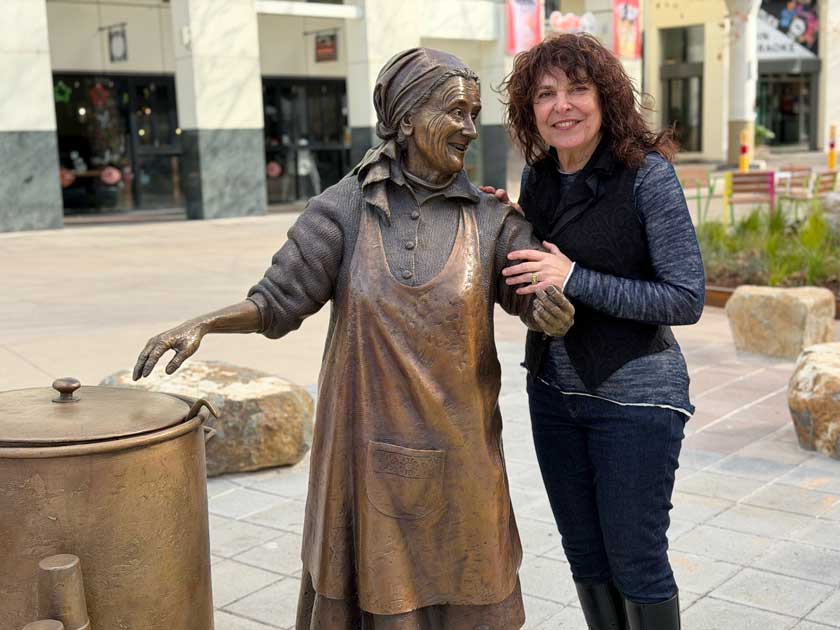
Louise Skačej with the sculpture in its new home of Garema Place.
Public sculptures are often made larger than life. However, this time Louise deliberately chose not to dramatically enlarge Stasia. In fact, the likeness being unveiled in Garema Place today (Friday, August 7, 2026) mirrors The Soup Kitchen Lady’s real life diminutive proportions.
“I felt like the interplay between the scale of Stasia and her actual height and the power of Stasia, was poignant,” Louise says.
Making her taller, she explains, would have diminished the remarkable contrast between her modest physical stature and the force of her character.
The clothing mattered too.
“The tactility of it and the draw to touch is fundamental in my process.”
It’s characteristic of Louise’s work, which frequently explores texture as a way of inviting viewers into an emotional, almost physical relationship with sculpture.
Again and again, Louise returned to feelings before technique.
“If I tap into the emotional side of things, it helps me clarify my thinking.”
Perhaps that’s why this sculpture feels different.
It isn’t trying to elevate Stasia onto a pedestal.
Instead, it asks us to stand beside her.
The question of whether Stasia herself would have welcomed such a tribute is one Louise doesn’t avoid. Instead, she reframes it.
“What this sculpture does and will do for generations, because it will last, is that it doesn’t just memorialise her, but it brings visible her purpose and the community she was serving.”
“It’s very much about keeping the whole story visible and in people’s consciousness.”
It’s a powerful idea.
For decades, Stasia quietly noticed people many others walked past. She fed them, hugged them, found them blankets, listened to their stories and reminded them they mattered.
Now, through Louise’s work, it is Stasia who will become impossible to overlook.
“It’s easy to underestimate the power of art,” Louise says. “It’s easy to see it as an indulgence.”
Standing permanently in Garema Place – the very place where Stasia spent decades quietly changing lives with little more than vegetables, determination and compassion – this sculpture suggests otherwise.
Some sculptures preserve history.
This one carries it forward.
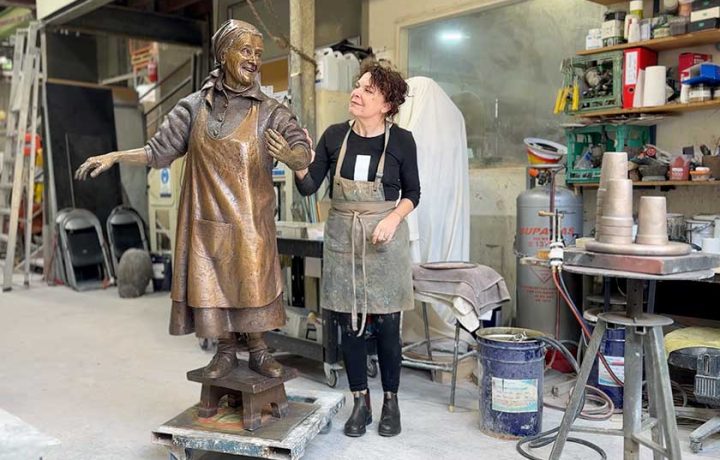
Photo of Louise Skačej at Meridian Foundry with bronze Stasia by Aludean Studio