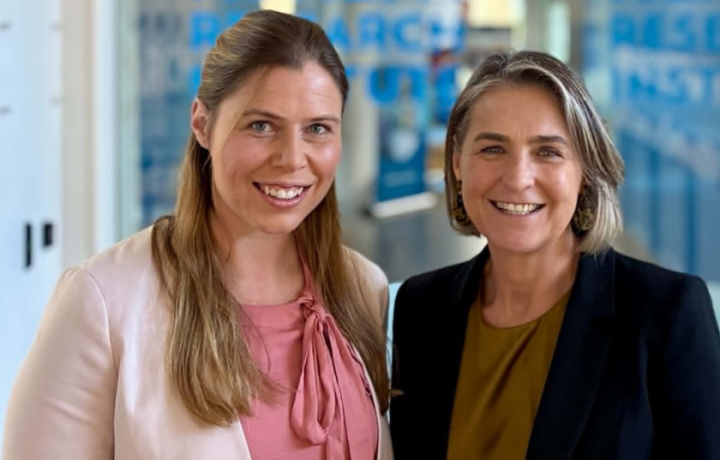
How I Got Here: Director FARE, Katherine Berney

Posted on
Admit it, we’ve all been there – stalking social media and LinkedIn profiles, trying desperately to figure out how the hell someone got their dream job.
It seems impossible and yet there they are, living out your career fantasy (minus the itchy business suit). It might seem hard to believe, but once upon a time, they were also fantasising about their future career, and with some hard work, they made it.
Welcome to How I Got Here, HerCanberra’s series that reveals everything you want to know about the secrets of career success.
Recently named the ACT Award recipient of the Australian Awards for Excellence in Women’s Leadership (presented by Women & Leadership Australia), Katherine Berney, Director of Gender Based Violence Prevention at the Foundation of Alcohol Research and Education (FARE), has made a significant impact on advancing women’s safety, equality, and representation through durable national policy reform.
The former Executive Director of the National Women’s Safety Alliance, she is at the frontline of some of Australia’s most complex and urgent challenges: gender-based violence, prevention policy, alcohol-related harm, and the structural systems that continue to place women and children at risk. Here’s how she got here.
Existential crisis time: Who are you and what do you do?
My name is Katherine Berney. I’m a mother and stepmother to three incredible children, a wife, a friend, and a long-time advocate working to end gender-based violence. I try to move through the world with empathy and purpose. I’m deeply values-driven, and I believe that if you have a voice, you have a responsibility to use it to amplify others. I’m also the Director of Gender Based Violence Prevention at the Foundation of Alcohol Research and Education.
Let’s go back to when you were a kid, have you always dreamed of working in this industry?
I’ve always cared deeply about women’s rights, even if I couldn’t name it when I was younger. Back then, I wanted to be an opera singer – a long story for another time. Living in Vanuatu and working with the Red Cross was the turning point. Seeing the realities of gender-based violence so clearly changed the direction of my life. I knew then this was the work I needed to do.
Tell us about when you were first starting out, what set a fire in your belly to get here and how did you do it?
Having lived experience of domestic abuse, I believe deeply that recovery should be a right, not a matter of luck. I’m driven by the belief that change is not only possible, but it’s also essential if we want a functioning, just society. Using my voice to help drive that change feels both necessary and personal.
Recall a time when you wanted to chuck it all in; what did you tell yourself when it got too hard?
This work can carry heartbreak. Wins are hard-fought, and the cost can be heavy. What sustains me is the people, colleagues and comrades who remind me that none of us do this alone. Collaboration isn’t just helpful in this field; it’s our greatest strength, and it’s what makes the work survivable, and sometimes even joyful
What was your biggest break?
I’ve been fortunate to work alongside generous and exceptional leaders throughout my career, people who believed in me early and helped shape how I lead. From being told to back myself, to learning how to turn passion into strategy, each experience taught me something lasting. I’ve learned what kind of leader I want to be, and just as importantly, what I don’t want to be. Everything has been a lesson.
What’s the best piece of advice you’ve ever received?
From the remarkable Trish Bergin: “Kindness and empathy should be what we aspire to be known for as leaders, every day.”
What is it about your industry that you love and what makes you want to pull your hair out?
The competitive funding environment has created unnecessary divisions between people who are all deeply committed to the same outcomes. Fragmentation suits systems that prefer a divided sector. But collaboration is our most powerful tool, and when we work together, we are far more effective.
Tell us how you ‘stay in the know’, what media do you consume?
I read widely academic research, traditional media, pop culture, and emerging online discourse. All of it shapes how we understand gender-based violence.
I’ve been particularly interested in cultural moments like the response to Heated Rivalry, where audiences responded strongly to narratives without a power imbalance. These cultural conversations matter because they influence how people imagine relationships and that has real-world policy implications.
Where do you see yourself in five years?
In five years, I hope to still be doing work that meaningfully shifts systems rather than simply responding to their failures. I want to be focused on prevention, accountability, and long-term change work that reduces harm before it escalates, rather than managing it after the fact.
I also hope to be working in ways that are more collaborative and sustainable. This field asks a lot of people, often at personal cost. I’d like to help build models of leadership and advocacy that are rigorous, generous, and honest about power, while still leaving room for care, innovation, and joy.
Why should people follow in your footsteps?
I don’t think anyone should follow my footsteps exactly. This work needs many approaches, many voices, and many ways of leading. What I would encourage is a commitment to staying principled when the work gets difficult, and curious when certainty is tempting. The most meaningful change I’ve seen has come from people who are willing to sit with complexity, challenge systems that protect themselves, and keep going even when progress is slow or unpopular.
If my path shows anything, it’s that you don’t have to fit a single mould to contribute, but you do need to be willing to use your voice, take responsibility, and work alongside others.
What advice would you give your past self?
You don’t have to earn your place through exhaustion. Your insight, care, and perspective are valuable even when you’re still learning. It’s okay to take up space, to ask hard questions, and to set boundaries, especially in work that asks you to give so much of yourself. Trust that consistency matters more than perfection, and that staying in the work, with integrity intact, is an achievement in itself. And even in the darkest of time the spirit of Katherine is irrepressible.