How I Got Here: Science Communicator, Isabel Richards
Posted on
Admit it, we’ve all been there – stalking social media and LinkedIn profiles, trying desperately to figure out how the hell someone got their dream job.
It seems impossible and yet there they are, living out your career fantasy (minus the itchy business suit). It might seem hard to believe, but once upon a time, they were also fantasising about their future career, and with some hard work, they made it.
Welcome to How I Got Here, HerCanberra’s series that reveals everything you want to know about the secrets of career success. This week, Science Communicator Isabel Richards sits down to share how she co-founded a podcast that focuses on the intersection of science, popular culture, and entertainment and where her passion for making science more accessible comes from.
Existential crisis time: Who are you and what do you do?
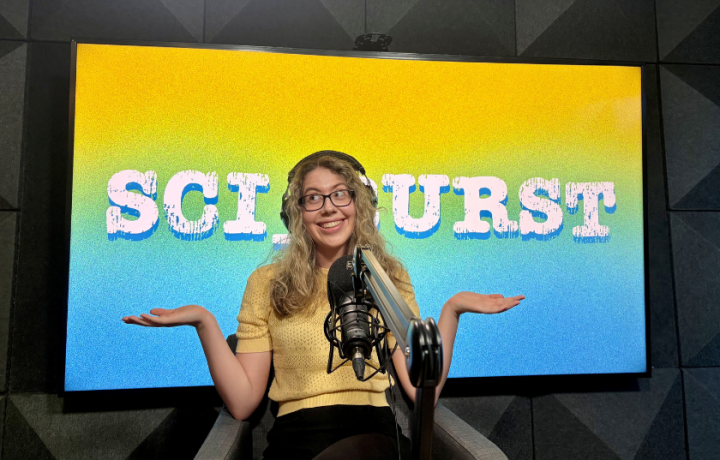
Hi! I’m Isabel, and I’m a Science Communicator and co-founder of Sci_Burst – a startup that communicates STEM concepts via popular culture (your favourite movies, tv shows, video games, books, and more). I have a deep passion for inspiring hopeful, sustainable futures and bringing science to people who might not feel like it’s for them. I burst science out of its ivory tower with my best friend and business partner, Ella, and help make science accessible for non-experts in creative, 21st-century ways. Our work covers things like representations of STEM girls in teen media, science and engineering in Minecraft and farming simulations, AI panic, depictions of queer science in fiction, Pokémon science, sustainability and solarpunk media, and so much more.
Let’s go back to when you were a kid, have you always dreamed of working in this industry?
I never dreamed of being a science communicator (I didn’t know what it was as a kid, and it’s still an emerging profession). But growing up, I used to say I wanted to be a teacher. And as a Science Communicator, I’ve definitely become a type of teacher, just not in the traditional sense of the profession!
Tell us about when you were first starting out, what set a fire in your belly to get here and how did you do it?
My passion for science communication was ignited on my first day at university. I realised that most people in the world aren’t scientists or STEM experts, and so science can feel like this intimidating, confusing thing for a lot of people. And some of those negative associations come from the way STEM – particularly maths – is portrayed in pop culture. There’s also a lot of misinformation and disinformation out there, especially with the rise of social media and Artificial Intelligence, which can be really tricky to navigate. For these reasons, I saw science communication as an extremely important field for our time and wanted to be part of it.
In particular, I wanted to build something creative and knew that pop culture was a powerful way of reaching people because of its entertaining stories and relatability. Hence Sci_Burst!
How exactly did I do it? Honestly, both Ella and I just threw ourselves into it without much of a plan. We started as a podcast, and one day just booked a recording studio and turned on the mics. The more we created, the more visible we became and started expanding into workshops, live events, writing, and lots of other projects. The rest is history!
Recall a time when you wanted to chuck it all in; what did you tell yourself when it got too hard?
I recently experienced my ‘quarter-life crisis,’ as they say. I faced a devastating situation in the workplace and, at exactly the same time, received a chronic disease diagnosis. It was heartbreaking and the lowest I’ve ever been. For a while there, I felt like an NPC.
But I read this amazing book – Person in Progress: A Road Map to the Psychology of Your 20s – by Jemma Sbeg that marked my turning point. She has lots of valuable advice in there, and I highly recommend it for any twentysomething going through a rough patch, but one snippet that stood out for me was this: “The biggest antidote to a crisis is movement in any direction that feels meaningful.” And that helped remind me that hard moments, losses, and discomfort are how we grow as people – extraordinary growth rarely happens when things are easy. After all, diamonds are made in the rough!
What was your biggest break?
I think it was my time at The Australian National University. I completed my undergraduate degree there, jumped around a few roles after graduating, and met several incredible people at the University who believed in us and opened doors for Sci_Burst. I wouldn’t be where I am today without their kindness, their generosity, and their mentorship. It’s also where I met my best friend and co-founder, Ella. Sci_Burst wouldn’t exist if we didn’t both enrol in science communication at ANU at the same time!
What’s the best piece of advice you’ve ever received?
Career-wise… Take more risks and be more ambitious. Especially as a young person. Your twenties are the best decade to take a huge leap of faith, step out of your comfort zone, or do something unexpected. You miss 100% of the shots you don’t take.
Life-wise… Kindness is the highest form of intelligence. That one was my late grandfather.
What is it about your industry that you love and what makes you want to pull your hair out?
There are lots of things I love about science communication, and one of my favourites is how interdisciplinary it is. The biggest reason I chose science communication was that I could combine my love of STEM with my love of Literature and the Humanities. Both skill sets are extremely important for excelling in science communication. I also love that I get to work with people who come from completely different backgrounds and industries than I do.
Something I don’t love is the way it’s often misunderstood, not seen as being part of STEM, or not viewed as valuable by other industries. I feel like I’m constantly having to explain the importance of science communication and how, yes, there’s overlap, but it’s very different to the field of “communications” more generally.
Tell us how you ‘stay in the know’, what media do you consume?
Staying in the know is second nature to me as it’s an essential part of the job as a science communicator… and one who specialises in popular culture. I read all sides of the news and lots and lots of books (all genres, fiction and non-fiction), I pay attention to online trends, I watch a range of movies and tv series, and I spend plenty of time playing video games. I’m forever upskilling and exploring perspectives or experiences that differ from mine.
Where do you see yourself in five years?
As an established expert and entrepreneur in the realm of science communication and popular culture. Ella and I have grand plans for Sci_Burst!
Why should people follow in your footsteps?
If you’re interested in STEM but want a career that’s outside of the lab and a little less conventional, science communication might be the pathway for you. You can be a science writer, science policy adviser, science exhibition curator, science performer, science podcaster, science in pop culture researcher, or all of the above! If you care about making science and critical thinking accessible for more people, it’s the way to go.
Also, the interdisciplinary collaborations and, if you’re a woman, the impact you will have on young girls is very fulfilling and joyful.
What advice would you give your past self?
Dream bigger and bolder. And don’t feel like you have to ‘pick’ between STEM and the Arts/Humanities. Find a way to do both.