A Ticket to Paradise? The story of many who have travelled afar

Posted on
The National Archives of Australia’s recent work has been thoroughly impressive.
The last few exhibitions I’ve been to have been stimulating, fresh and beautifully designed and presented. A Ticket to Paradise? is another that ticks all of those boxes. The exhibition booklet is in the form of a passport, suitcases adorn the entrance and colourful, airmail bands and stamps feature throughout the exhibition at the bottom of panels…I just love the look.
The exhibition team had the daunting job of choosing what to include in the exhibition from 22,000 images. Starting with Cabinet submission documents that display the decisions made by governments, the exhibition then takes personal images, mementos and migrants’ oral histories to demonstrate the significance of those decisions and the outcomes, essentially bridging the gaps between government decisions and showing how such policies influence migration patterns and individuals.
One such image that demonstrates this is a favourite image of the exhibition’s researcher, Michelle. The image shows a Philippine family at home going through their record collection and looking quite hip for the 1970s.
Michelle selected this image because it illustrates the shift from European migration to broader migration and how media was used to promote this to potential migrants and those who already called Australia home.
Incorporating contributions by visitors is a strong element of A Ticket to Paradise? and means that the exhibition is not static. Potentially in three months time, when the exhibition closes, it will be substantially different to how it is presently. Data will be continuously updated as new stories are added.
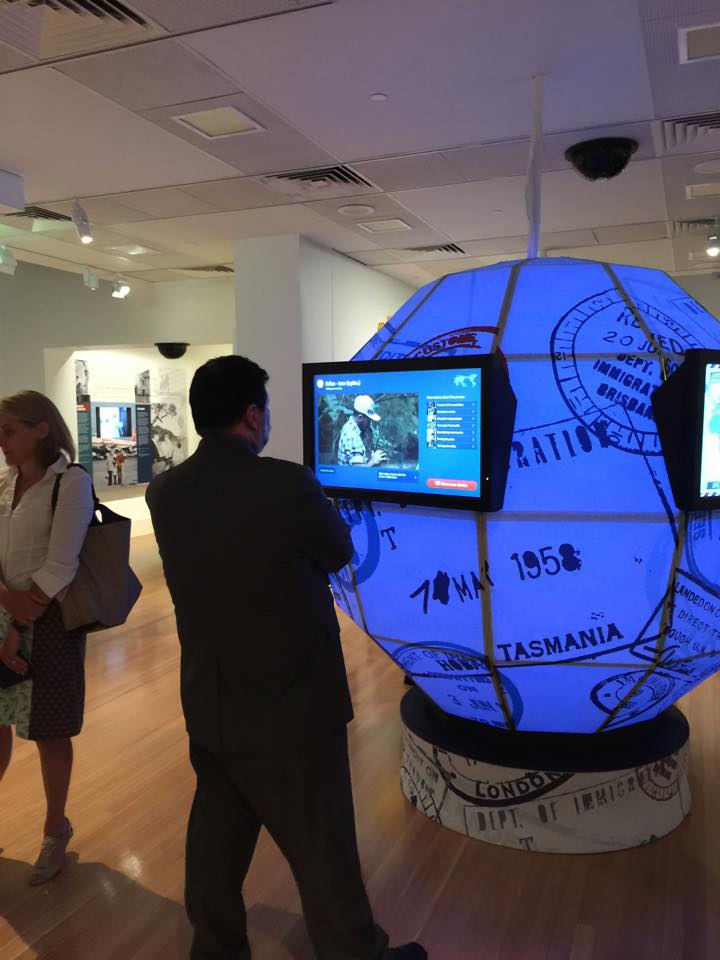
Interactive in every sense, the exhibition is constantly evolving and by the time it closes in March 2015, will be vastly different to the exhibition that opened last month.
Visitors can follow interview prompts on an iPad in an easy to navigate program, which then uploads to the interactive globe and becomes part of the exhibition.
As every individual’s migration experience is different and complex in its own way, this aspect of the exhibition is exciting as it enriches the visual and story aspect of migration as the data updates.
Eight recent migrants’ stories are displayed in the exhibition, the most recent having migrated in 2008. I had the opportunity of speaking with Noonee Dornilla, who migrated to Australia from the Philippines as a teenager. Noonee enjoyed being a part of the project and laughed as we watched her interview clips for the first time on the special interactive globe.

The first assisted Turkish migrants arrive in Sydney, 1968. From the photo library of the National Archives Australia with photo credit by Department of Immigration and Multicultural and Indigenous Affairs (DIMIA)
She says that her parents are proud of her involvement in the exhibition and considers that it is important to contribute towards assisting in understanding Australia’s multicultural society.
Today, more than one quarter of Australians were born overseas and nearly half of the population have at least one overseas born parent. As I fall into both of these camps, I plan to return and have a go at leaving my own story as well as observing how the exhibition has evolved. The Australia of today can be traced back through government decisions, but it’s the stories of everyday people that truly illuminate the legacy of those policies.
On Thursday, the world will celebrate International Migrants Day—a day of global solidarity with migrants in recognition of the UN’s International Convention of Migrants’ Rights, which was adopted in 1990 and of the 232 million people who’ve left their home country in search of a better life. So why not celebrate your story, and head to this intriguing exhibition to find out more?
The essentials
What: A Ticket to Paradise?
Where: National Archives of Australia, Parkes
When: 9am to 5pm daily until 9 March 2015.
How much: Free entry
Web: www.naa.gov.au


Leave a Reply